Contact
“We use light corridors to manage the flow of people” - expert on night lighting at Svet Expert
18 January 2021
Blog

“We use light corridors to manage the flow of people” - expert on night lighting at Svet Expert

The founder of an international architectural and lighting company, an expert on nightlighting of buildings and public spaces, told Ilya Ivanov about the difficulties of getting used to “business in Russia”, the effect of lighting on the production of hormones of vigor and sleep, the difference between accent and marking lighting, and why it is necessary to illuminate the facades of houses in the dark.

You didn’t immediately settle in Moscow?

My roots are in Dagestan, I was born in the Republic of Komi, and lived there until the end of eighth grade. It so happened that at the age of 14, I ended up in Bulgaria. I studied there and also in Greece, so I am fluent in Bulgarian and Greek. In principle, my homeland is Russia, the Russian Federation in general, but until 2012, I lived in Bulgaria.

Your light is not hereditary?

Not hereditary in any way. My entry into this field was completely accidental. Education has nothing to do with light. I was accidentally introduced to a person who was engrossed in this area of business. He represented the interests of a number of manufacturers of indoor lighting in Bulgaria. And during that period, the Bulgarian Black Sea coast was actively being built up - four- and five-star hotels of a high level began to appear there, the type of lighting also had to correspond. And since 2004, we have partnered with this person.

But now you are a sought-after Moscow expert on outdoor lighting of buildings, public spaces.

I will explain: in 2008, I decided that we needed to specialize in a new direction, because the Chinese have erased all boundaries - they copied all those Italian and Spanish chandeliers and lamps that we offered to our clients, and threw them on the market at a price three, four, or even five times cheaper than it costs in the original. It was extremely difficult for us to interact with clients who sought to optimize the cost of their projects by buying replicas.

And then we realized that our deep specialization in one field is actually useless, we were undercut, our deep expertise in this business was useless. I offered the partner to move to the architectural direction, to the illumination of open spaces, buildings and structures. He said, “No, I’ll continue to deal with indoor lighting,” and then I went out on my own..

Did you start working in the Bulgarian market?

Throughout the Balkan Peninsula, we worked with our neighbors. You know, geography is not that big, I could jump in a car if necessary and be in Athens in nine hours. Our expertise had already appeared there and we started strengthening it. Few people were doing that in the Balkans, and I would say that even now very few people are doing it professionally. In Russia much more attention is paid to it than on the Balkan Peninsula.

Maybe they don’t have as long a tradition of illuminations as Russia does?

We’re dark outside for half the year. Peter the Great, in honor of his victory over the Swedes, started installing oil lights in the 17th century. And if I’m not wrong, a few years later, he installed the first permanent kerosene lights in St. Petersburg. Then we switched to gas lights.

Yes, Peter had issued several decrees on the installation of oil lanterns in Moscow in various years, but these were actually only started to be installed in large numbers at the beginning of the reign of Anna Ioannovna, in 1730 and 1731, when the empress lived in Moscow after her coronation for two years. Have you begun to deal with illuminating buildings in cities?

In Bulgaria, European urban development programs have started. Thanks to Bulgaria’s entry into the EU, subsidies from the EU have started arriving. City administrations themselves have started contacting us. Of course, the post-Soviet Bulgarian government certainly didn’t have funds for this before.

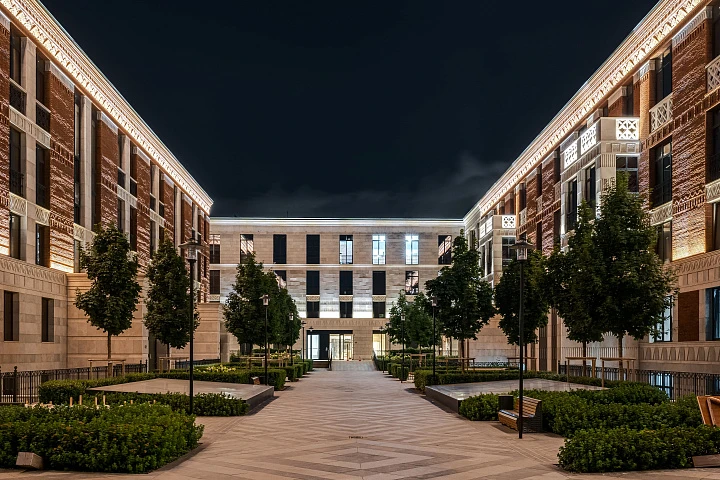
Depending on the purpose – a residential complex, a mall, a business center – we put on some kind of a night suit for a building.

At first, they did not understand how to do this, who the chief architect of the city is, what his task is, what coloristics is. In Bulgaria, we illuminated parks, squares, architectural monuments, and began to understand that lighting is not only for demonstrating the beauty of an object at night, but it is really a tool for managing human flows.

By forming so-called light corridors, we manage human flows to the point where they go where the lights are warmer, and not where it is “cold”. On a psychological level, we have begun to identify these processes and demonstrate them on our buildings, which we develop, of course, depending on their purpose — a residential complex, mall, business center. We put them all in a kind of night suit.

Have you encountered many competitors working with private developers and the city government when you entered the Moscow market?

We did not immediately enter the Moscow government. And what’s more, I can say that we always treat working with government projects and orders with great caution. I took a long time to get used to what I call “business in Russian.” There are certain features that books about business do not write about. And I was not used to this in Bulgaria. I had to get used to the peculiarities of doing business in Russia for a long time, it was difficult, I had to adapt.

But we positioned ourselves as a global Russian company. From the very beginning, we had a European approach - packaging commercial offers and, most importantly, visualization. If a client contacts us, he has a photo of a building, he sends it to us, we literally send a visualization with a budget cost estimate within a few hours.

However, we did not always meet the price. Very often, our visualizations ended up on the desks of our competitors. But we entered all regions of the country, people heard about us, they began inviting us to discuss certain projects, including regional and Moscow government representatives, because for them it was also a novelty. For example, when they had to prepare the city for an event for the next anniversary of the city.

Next year marks the 800th anniversary of Nizhny Novgorod; they are preparing for it there intensively.

We are among the authors of the lighting project for Nizhny Novgorod, we participate in developing the concept of the lighting master plan timed to coincide with the anniversary of the city, we participate in the development of outdoor and facade lighting of objects inside and outside the Kremlin’s fortress walls; there are about 300-odd objects in total: streets, bridges, buildings, parks, and squares.

And what about Moscow?

In Moscow, we do not work with the city government yet, but we speak at forums, participate in considering concepts, give our expert opinion on them, and that’s it. In Moscow, we work not with the city, but with private developers. Probably, there is no private developer in Moscow with whom we would not work at least at the stage of developing a concept or the composition of an expert council. We have many large projects.

As for highlighting private projects, there are people close to the authorities who interact with these orders. I would also gladly receive these orders. Frankly, government orders are usually formed based on budget, they tell us: ‘We have such and such a budget, we are ready to spend it on lighting.’ We are probably one of the few who do the maximum within the agreed budget.

You moved from Bulgaria in 2012. How have you found Moscow in these eight years?

Moscow has changed a lot. There are now many companies that have started to apply architectural lighting techniques competently. There are certain peculiarities of architectural lighting. For example, there is static lighting - this is when we take architectural monuments and illuminate them simply with accent light, emphasizing the features. This requires lighting technicians and architects who, having studied the architecture of the object and the environment, think about how it can be highlighted and presented in the best light.

And there is another story - dynamic lighting. We are surrounded by new, fashionable construction, high-tech, in ‘Moscow City’ we are currently working on one of the skyscrapers, the ‘Eurasia’ tower.

And how do you like the overall lighting of ‘Moscow City’? It can be seen from dominant points almost all over the city.

The lighting of Moscow City has not yet been fully formed, there is no single concept. Initially, this architecture as a whole is all new to us, but this is inevitable, because this is the future. It is normal for us to try to build huge multifunctional complexes on some small piece of land - this is necessary, this is inevitable.

I have friends who live and work in Moscow City. These people are not affected by the weather outside - snow, rain; they go down to their office in slippers, they have lunch and meet people there, they do not leave there. Moscow City has its own microclimate in which people live.

In the evening, we create a warmer light that contributes to the production of melatonin, the sleep hormone - the host, you are back home, you need to rest.

But in our case, the fact is that modern high-rise architecture cannot be illuminated using classical techniques of accent, static lighting. It should be illuminated by means of marking lighting, dynamics, like, for example, the Evolution Tower - a spiral that is very well illuminated in dynamics. We specialize in this direction - in dynamic lighting.

And maybe it makes sense to highlight monuments of architecture dynamically, why not?

By the way, the Kremlin in Nizhny Novgorod will be illuminated dynamically. The project is not ours, the Nizhny Novgorod company “Prom Svet”, which completely designed this solution, we took the implementation for ourselves. A dynamic lighting system is built into it. What is it: spotlights are used that are aimed at the facade of the wall and towers of the Kremlin, and they have the function of floodlighting with the possibility of changing colors. For a festive mood, you can highlight the Kremlin in different colors, switch to change colors. On weekdays, the Kremlin will be illuminated with a classic white stationary glow. Again, this is all a matter of taste. I believe that monuments of architecture are solid, serious objects, and you better not experiment with them. To highlight a monument in different colors of the rainbow - well, no, no.

A church is probably not worth highlighting like that either?

This will be perceived as disrespect. According to monuments of architecture: here we have an object on Ostozhenka, it is unique, a private company bought it, restored it and turned it into an office. Architecture with ornaments, copper roofing. We worked with this object and decided on a non-standard lighting technique, because usually they highlight planes and elements of architecture, highlight them with light. We went the other way around - we highlighted the window openings, supplying a large amount of light flux there, which will lie on the entire external decor with sliding light, and it will, on the contrary, emphasize it, as if they themselves have such an internal glow.

But this reception cannot be used if the building is residential. Imagine, you go to bed, and spotlights hit your windows - you will feel uncomfortable. If it is a hotel, again, we should not disturb the guests with our light.

An office building can be highlighted in this way, a public building can, because, as a rule, no one lives there, does not sleep at night. We approach each object individually, depending on its purpose, architecture, and environment. For a shopping center, we will create maximum light dynamics in order to attract the attention of all those passing by, passers-by, the entire human flow. We study the location of the object, how it is viewed from where, its views from different angles, in order to encourage a potential buyer to pay attention to this object, show interest in it, enter the shopping center. We work out lighting control programs for certain periods of time - at five o’clock in the evening, the lights begin to burn as dynamically as possible, because the working day is ending, people leave work, drive past - we need to “invite” them to the shopping center.

Another concept is ‘emotional lighting’, which is a white light ranging from warm (3000K) to cool (6000K).

Does emotional lighting affect people’s emotional state?

We live in Russia so for most of the year when we leave to go to work it is still dark, and when we come back it is already dark. The emotional lighting is so called because when you get up in the morning you feel sleepy and when you come outside you are greeted by colder lighting in your residential compound area. At the same time your body produces cortisol, a hormone that helps you to wake up, to stimulate your brain. Your emotional state improves, you become more alert. In the evening we create warmer light which helps produce melatonin, a sleep hormone. It’s like a signal to your body: ‘You’re home, you need to rest.’ Lighting affects everyone’s emotional background.

Is this some European, American or Asian development that you are implementing in elite residential complexes under construction in Moscow?

We are actively exploring international experience. Yes, we are interested in how, who, and where all this is done. Several global manufacturers of lighting equipment have released something similar, even down to desk lamps working on this technology (Tunable White), just like the displays of phones. Have you noticed that in the morning they have a cold glow and in the evening a warmer one? Absolutely the same.

But in Moscow, not everyone lives in prestigious residential complexes with a closed internal garden, parking lot, and smart lighting. Returning to street lighting, at the layman level, many say: why do we even need it? A lot of money is spent on it. Indeed, why do we need it?

It increases the level of comfort for all city residents. People feel safer, including late at night, their mood improves. Both in summer and in winter, you want to walk along the streets, including at night, because it’s light there, safe, comfortable. Many people forget about this comfort, focusing on how much is spent, and don’t remember how hostile the city was in the dark some ten years ago, when this did not exist or was very scarce.”

Source: moskvichmag.ru

Other news